investment guide
Understanding Rubber Tree Investment Cycles: A Comprehensive Guide for Strategic Investors
Rubber tree investment represents one of the most stable and rewarding opportunities in agricultural asset classes. Understanding the distinct lifecycle phases is essential for investors seeking long-term, predictable returns.
Dr Desire
January 15, 2026
$48.5B
Global rubber market 2025
4.58%
Annual growth rate (CAGR)
12-18%
Internal Rate of Return
25+
Years productive lifespan
The Economic Foundation of Rubber Investment
The global natural rubber market, valued at USD 48.5 billion in 2025, is projected to reach USD 60.7 billion by 2030, growing at a compound annual growth rate of 4.58%. This growth is driven by expanding electric vehicle production, where EV tires require approximately 15% more natural rubber than conventional alternatives, alongside sustained demand from healthcare and construction sectors.
Unlike synthetic alternatives, natural rubber’s unique molecular structure provides superior elasticity, heat resistance, and durability, properties that cannot be fully replicated by petroleum-based substitutes. This irreplaceable quality underpins the long-term demand stability that makes rubber plantations an attractive investment vehicle.
Phase 1: Establishment Period (Years 0-2)
The establishment phase encompasses land preparation, planting, and early cultivation. During this period, the primary capital expenditure occurs: land acquisition, soil preparation, seedling procurement, and infrastructure development including irrigation systems and access roads.
Quality seedling selection is paramount. Budded clones from high-yielding parent stock, such as RRIM 600, RRIM 900 series, or PB 260, can produce 30-40% higher yields than unselected material over the tree’s productive lifespan. The initial investment in premium planting material typically represents less than 5% of total establishment costs but directly correlates with long-term profitability.
Key Investment Considerations: Establishment Phase
- Land suitability assessment including soil pH (4.5-6.0 optimal) and drainage
- Clone selection based on regional climate and disease resistance
- Planting density optimization (400-500 trees per hectare standard)
- Cover crop establishment for soil health and erosion control
Phase 2: Immature Period (Years 3-6)
During the immature phase, trees develop the girth and bark thickness necessary for commercial tapping. This period requires consistent maintenance, fertilization, weeding, pest management, and formative pruning, but generates no direct revenue from latex production.
Intercropping strategies during this phase can significantly improve investment economics. Shade-tolerant crops such as bananas, pineapples, or leguminous cover crops can generate interim income while providing soil nitrogen fixation and organic matter. Research from the Rubber Research Institute of Sri Lanka indicates that well-managed intercropping can offset 40-60% of immature period maintenance costs.
Trees typically become tappable when their trunk girth reaches 50cm at 1 meter height, usually achieved between years 5-7 depending on clone characteristics, soil fertility, and management practices.
Phase 3: Early Production (Years 7-12)
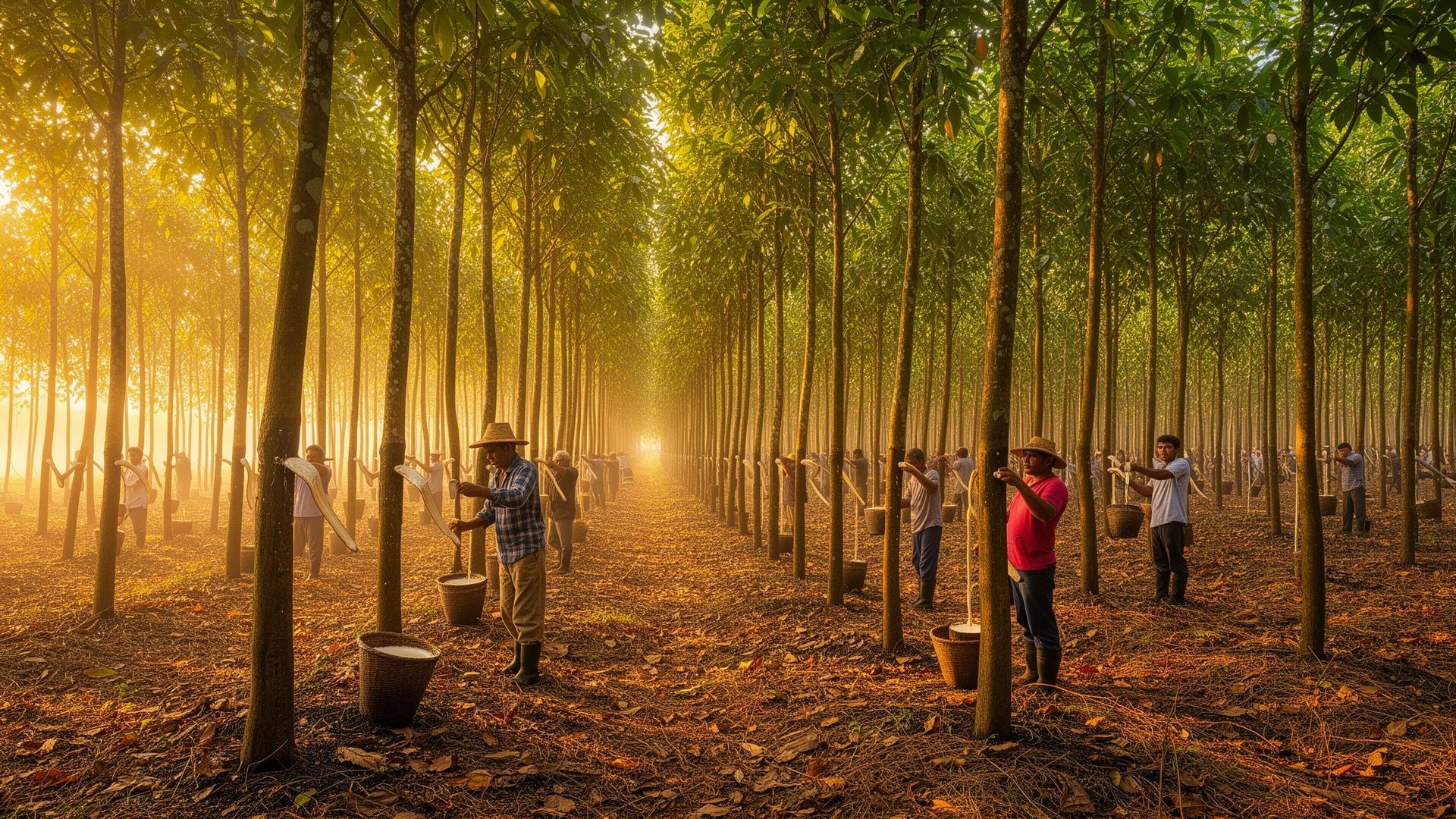
Initial tapping marks the beginning of the cash-generating phase. Yields start modestly, typically 800-1,000 kg of dry rubber per hectare annually, and progressively increase as the tree’s laticiferous vessel system matures and tapping panels are optimized.
Tapping technique significantly influences both immediate yields and long-term tree health. The half-spiral, alternate daily tapping system (S/2 d/2) has emerged as the industry standard, balancing latex extraction with bark regeneration to ensure sustainable productivity across the tree’s economic life.
Phase 4: Peak Production (Years 13-22)
The peak production period represents the most profitable years of the investment cycle. Mature, well-managed plantations can achieve yields of 1,800-2,200 kg dry rubber per hectare annually, with elite operations exceeding 2,500 kg/ha under optimal conditions.
During this phase, operational efficiency becomes the primary determinant of profitability. Labor productivity, disease management (particularly South American Leaf Blight prevention in vulnerable regions), and market timing of sales all contribute to return optimization.
Peak Production Economics
At current market prices of approximately USD 1.75-2.20 per kilogram, a well-managed hectare can generate gross revenues of USD 3,500-4,800 annually during peak production, with operating margins typically ranging from 35-50% depending on labor costs and processing infrastructure.
Phase 5: Declining Production (Years 23-30+)
As trees age, latex yields gradually decline due to bark exhaustion and physiological aging. However, innovative harvesting intensification techniques can extend profitable production. Research indicates that controlled reduction of the production cycle to 21-25 years through intensified tapping can optimize total lifecycle returns, particularly when combined with rubber wood harvesting.
End-of-life trees represent a significant secondary asset. Rubber wood has emerged as a premium sustainable timber for furniture manufacturing, construction, and biomass energy. Current markets value mature rubber wood at USD 800-1,500 per hectare, providing a substantial liquidation value that enhances overall investment returns.
Investment Return Projections
A comprehensive financial analysis of rubber plantation investment reveals compelling long-term returns. Based on 25-year discounted cash flow models using conservative yield assumptions and current price indices:
- Internal Rate of Return (IRR): 12-18% depending on land costs and management efficiency
- Payback Period: 8-10 years from initial investment
- Net Present Value: USD 8,000-15,000 per hectare at 8% discount rate
- Total Lifecycle Revenue: USD 45,000-65,000 per hectare over 25 years
These returns compare favorably with traditional real estate investments while offering portfolio diversification benefits through low correlation with financial market movements and inherent inflation hedging characteristics.
Risk Factors and Mitigation Strategies
Prudent investors must consider biological, market, and operational risks inherent in tree crop investments:
Disease Risk: Fungal diseases including Phytophthora leaf fall and Fusicoccum bark disease can significantly impact yields. Geographic diversification across disease-free zones and selection of resistant clones mitigate exposure.
Price Volatility: Natural rubber prices exhibit cyclical fluctuations tied to oil prices and industrial demand. Long-term investment horizons of 20+ years smooth these variations, while production cost optimization ensures profitability across price cycles.
Climate Risk: Extreme weather events pose threats to plantation productivity. Site selection in optimal climate zones (10°N-10°S latitude, 2,000-3,000mm annual rainfall) and insurance coverage address this exposure.
Conclusion: A Strategic Long-Term Asset
Rubber tree investment offers sophisticated investors a unique combination of income generation, capital appreciation, and portfolio diversification. The biological growth cycle, while requiring patience through immature phases, delivers predictable cash flows during the extended production period that can span two decades.
Success requires partnership with experienced plantation managers who understand the agronomic, market, and operational nuances of tree crop agriculture. With proper due diligence and professional management, rubber plantation investments can serve as cornerstone assets in wealth preservation strategies oriented toward generational time horizons.
About the author
Dr Desire
Investment Analyst
Related Insights
Ready to Invest?
Schedule a consultation to discuss how agricultural investments can fit your portfolio.